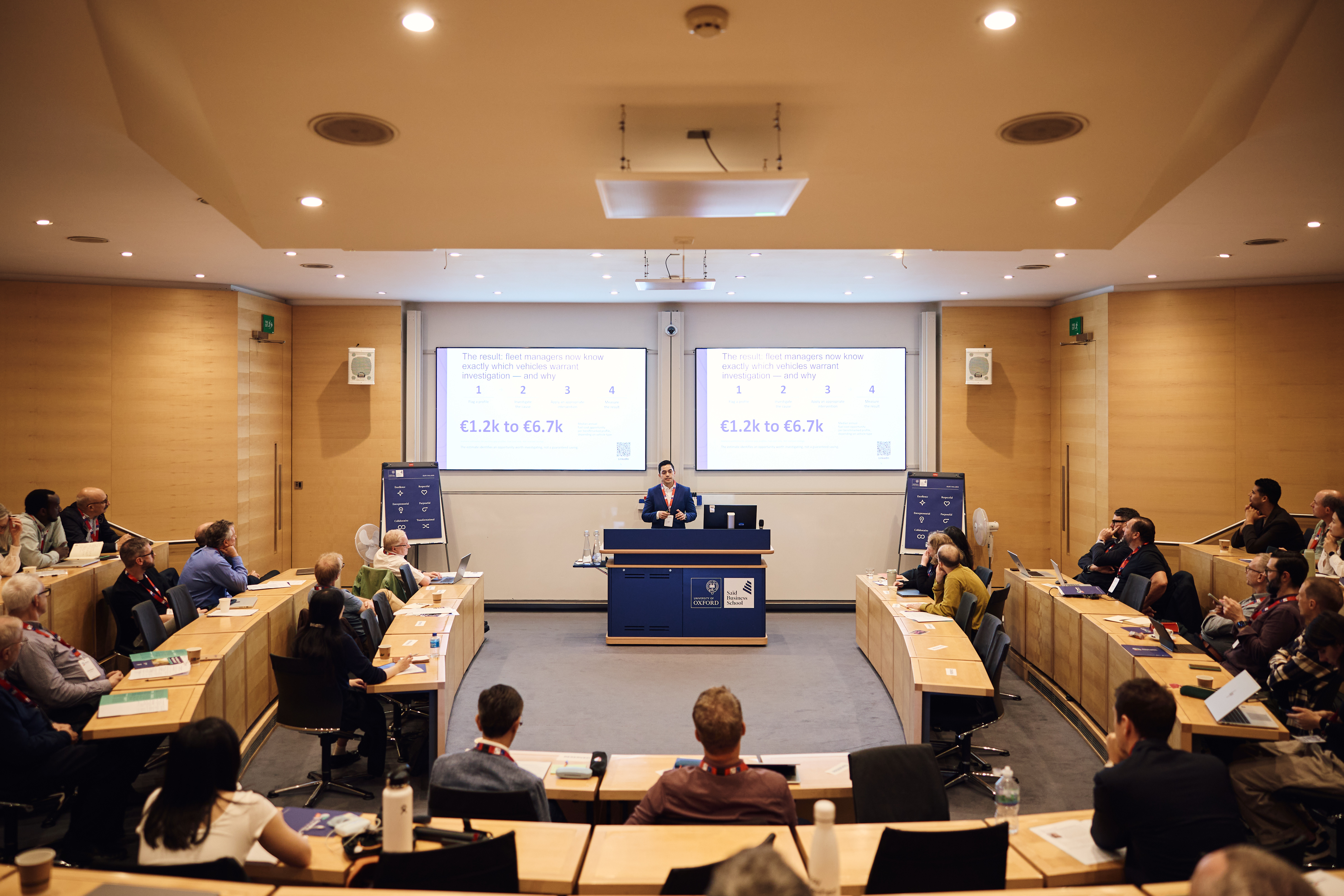
This year, 18 organisations from industry, government and the third sector partnered with the Geographic Data Service (GeoDS) to sponsor 26 projects through the GeoDS Masters Dissertation Scheme, supported by Smart Data Research UK (SDR UK).
Masters students from universities across the UK participated in the scheme in 2026, attending our annual Data Partner Forum in September, at the Saïd Business School, University of Oxford, to present their research and attend the prize-giving ceremony for the top three dissertation projects.
About the GeoDS Masters Dissertation Scheme
The GeoDS Masters Dissertation Scheme offers an exciting opportunity to link masters students, their university supervisors and leading smart data organisations, through projects that harness smart data to solve business-critical problems.
GeoDS has successfully run the scheme for over a decade, previously as the Consumer Data Research Centre (CDRC), providing students across a wide range of disciplines in any UK university the chance to enhance their academic experience and professional prospects, and enabling industry and other external partners to leverage their data assets and advance strategic initiatives.
“One of the Masters Dissertation Scheme’s greatest strengths is the way it brings academic expertise and industry partners together, showing how collaboration can drive innovation. These partnerships also help researchers turn data-driven insights into real benefits for organisations and society alike.”
— SDR UK Head of Programme Matthew Croston
Interesting in sponsoring a GeoDS Masters Dissertation Scheme project in 2027? Email us at projects@geods.ac.uk

First prize: Analysing financial vulnerability and spatial inequality using Registry Trust’s County Court Judgements data

In collaboration with Registry Trust, Keyu Chen (MSc Urban Spatial Science, UCL) won the first prize for her dissertation project, entitled “County Court Judgments, financial vulnerability and spatial inequality in England: A population-aware spatial analysis of cumulative registered consumer CCJs”.
Commenting on Keyu’s dissertation, the judges said: “An excellent dissertation that is exceptionally clear, well-structured and consistently focused. The research gap is established convincingly, and the analytical choices follow logically from the research question. Particularly strong is the way different measures and methods are given a clear purpose. The results are well explained, alongside the application of different mapping visualisations to illustrate the results. The discussion demonstrates a strong understanding of their substantive and policy implications. Overall, this is a rigorous piece of research.”
Registry Trust Senior Data Analyst Rezo Beradze said: “The scheme has been a fantastic way to unlock new insights from Registry Trust’s County Court Judgments data and demonstrate its value for research and public good. Seeing Keyu’s dissertation win the overall prize this year was particularly rewarding and shows how our data can help answer important questions.”
Access Registry Trust CCJ data from the GeoDS Data Catalogue.
Reflecting on her experience of the Masters Dissertation Scheme, Keyu said:
“The collaboration was an especially valuable part of my dissertation experience, providing important data that made it possible for me to explore the research question in a meaningful, evidence-based way. This experience showed me the value of bringing academic research and industry perspectives together.”

Read more about Keyu Chen’s dissertation.
Runner-up prize: Exploring commercial fleet telematics data to identify fuel-efficiency gaps with Mobito

In collaboration with Mobito, Daniel Hernandez Gramajo (MSc Artificial Intelligence and Digital Health, University of Westminster) won the runner-up prize for his dissertation project, entitled “Context-aware fuel-efficiency benchmarking from commercial fleet telematics: Trip-level archetypes and peer benchmarking across 1.17 million journeys”.
Mobito CEO and founder George Cambanis said: “At Mobito, advancing connected-vehicle data intelligence through R&D is central to our strategy. University collaborations help us explore and validate new applications in fleet efficiency, road safety and infrastructure intelligence. GeoDS has done an excellent job connecting industry with talented researchers across UK universities, fostering meaningful collaborations with real-world impact.”
Reflecting on his experience of the Masters Dissertation Scheme, Daniel said:
“This recognition means a lot because the project combined everything I hoped to achieve through my MSc: solving a real industry problem, applying data and machine learning in a practical way, and producing work with measurable impact. The scheme was a fantastic experience, and presenting the work in Oxford was one of the highlights of my MSc.”

Read more about Daniel Hernandez Gramajo’s dissertation.
Runner-up prize: Using Green Street retail data to understand how post-pandemic work and commuting patterns have shaped local retail landscapes

In collaboration with Green Street, Shuting Yang (MSc Urban Spatial Science, UCL), won the runner-up prize for her dissertation project, entitled “Exploring retail adjustment in relation to changing working patterns across London: A multi-source spatial analysis of office submarkets and commuting-linked residential areas”.
Access Green Street retail data on the GeoDS Data Catalogue.
Reflecting on her experience of the Masters Dissertation Scheme, Shuting said:
“Participating in the scheme was a truly rewarding experience. Working with industry data bridges academic research and practical applications, significantly enriching my geospatial analysis skills and clarifying my aspirations and ambitions within the fields of commercial real estate and retail.”

Read more about Shuting Yang’s dissertation
Get involved
If your organisation is interested in participating in the GeoDS Masters Dissertation Scheme in 2027, please register your interest by emailing us at projects@geods.ac.uk.
Each year, we facilitate a range of projects from organisations in industry, as well as in government and the third sector.
Project proposals are usually problem-focused and relatively open-ended to allow the student to devise their own research questions at the start of the research phase. Topics should consider consumers (or the population) or data generated by B2C transactions, and should be sufficiently critical to enable to the student to produce original academic research.
If you are unsure of a topic but would like to discuss opportunities to get involved, please do not hesitate to contact us at projects@geods.ac.uk.
Disclaimer
Comments have been edited for length.